5.27.2005

THINGS I AGREE WITH, FOR A CHANGE

It's time to give due credit to a couple of people I've been pretty hard on recently.

1) First, the Plain Dealer editorial page (which means Mr. Larkin, I presume). I agree strongly with every word of the lead editorial today, along with this one from last Saturday. Today's is about the state GOP's plan to cut the Local Government Fund budget for cities (but not villages) by 20%, and Saturday's was about the General Assembly's rush to legislate against cities putting up "red light cameras" to catch speeders and raise money. But they're both really about the same thing -- the determination of Republican state legislators to undermine both the financial resources and the home rule rights of Ohio cities. The Saturday headline said it well: What local control? Plan to stop drivers from running red lights is in jeopardy because the Ohio House wants to run Cleveland.

This is one of the most important and least discussed issues in Ohio politics. The mayors and city councils of Cleveland and other Ohio cities are expected to work miracles -- in neighborhood and downtown renewal, job creation, and school reform -- all while controlling crime, keeping the streets clean and the garbage collected. Legislators, especially those from rural districts, are never going to accept accountability for any of these things, and most are utterly clueless about big-city development and administration. Yet the General Assembly jealously controls cities' taxation and borrowing options. (The Local Government Fund, as the PD points out, is supposed to compensate local goverments for the limits imposed by state law on their property taxes.) And increasingly, the Statehouse GOP is acting to limit cities' non-tax authority as well, in violation of the spirit (if not the letter) of the Ohio Constitution's home rule provision, and usually in the service of some corporate special interest. Examples include:
-- the current red-light camera legislation;
-- the ongoing effort to preempt Cleveland's predatory lending ordinance with a toothless state law, which the Campbell Administration has challenged and has so far defeated in court;
-- a 2003 law that stripped municipalities of authority to regulate gas well drilling (HB 278);
-- a 2000 law restricting municipal operation of cable systems (SB 67):
-- the recently introduced House Bill 188, which limits local (and state) government "electronic commerce services" that compete with two or more private providers... which some are interpreting a a preemptive attack on municipal bandwidth initiatives, though it may also prohibit the sale of public documents by agencies to the public if some private firms want to act as brokers.
The PD editorialists are calling out the General Assembly's GOP leaders on a critical big-picture issue. This is a case where Larkin and Co. deserve strong support from people who care about our city.

2) For a similar reason, I want to give at least 2.5 cheers for Mayor Campbell's casino initiative. I don't think casinos are going to make much real difference in Cleveland's future, and I have no opinion about the political strategy Campbell and Austin are pursuing, but they've framed the issue absolutely correctly: This should be a local question, decided by local voters. Ohio cities (and the Democrats who lead most of them) have to start pushing back in defense of home rule and the right to shape our own futures. Otherwise cities will forever be trying to make bricks without straw. I'm looking for a petition to sign on this one.

3) Finally, a big thumbs up for the education op-ed in this morning's PD by Mayor Campbell's opponent, Council President Frank Jackson. You want real ideas to debate in the Mayor's race? Well, now we've got some. Jackson will have to answer a lot of questions about this gutsy piece (especially about how he thinks public and private school systems can coexist financially) but he's certainly put some serious meat on the table. And his two most "do-able" propositions -- some public schools in the city that are regional magnets, and free tuition for the first two years of college for city residents -- make extraordinary sense to me. (I continue to believe that sending Cleveland to college would be a lot better ED investment than a new convention center.)

So, Mr. Larkin, Mayor Campbell, Councilman Jackson... good on ya, and thanks!
a

5.24.2005

NO COMMENT: Enetation, the comment system I use here, has been on the blink for the last few hours and making the whole page load very slowly. So I've taken their link down, which means no comments until enetation fixes itself.
a
SYC "A DEPRESSING CLICHE": Just in case you missed it, architecture writer Steven Litt in yesterday's PD:
In design, Steelyard Commons is a depressing cliche. It consists of a long row of boxy stores facing a vast parking lot. Schneider has talked about gluing a veneer of faintly industrial architecture to the facades of the "commons" to evoke the muscular steel-making sheds of the past. But it's obvious the project will suburbanize a once robust industrial zone for which better uses could be found.

An exciting vision.
(Via the always excellent Cuyahoga County Planning Commission Weblog, which also has this.)
A

5.23.2005


1800 JOBS? Listening to the Steelyard Commons debate on "90.3 at 9", it occurs to me that I should re-post this from March...
"1800 PERMANENT JOBS": By now, if you live in the Cleveland media market you've heard it a hundred times: "Steelyard Commons would create 1,800 permanent jobs." This is the killer argument, the reason no sane community leader should do anything that might jeopardize the project.

But it doesn't have much to do with reality.

Let's assume that the new mall is built as projected, with five big-box stores (including an expandable Wal-Mart) and several dozen smaller spaces in adjacent strips. And let's assume the vacancy rate is low and the stores are very successful (you'll notice we're doing a whole lot of assuming). And finally, let's assume that the resulting work force is, indeed, around 1,800 people.

Does this mean we've "created" 1,800 new jobs? No, and here's why: New retail floor space doesn't create new retail jobs. Higher retail sales, i.e. more consumer spending, is what creates new jobs (sometimes). And since building a mall in the Flats will have no effect on the amount of money Cleveland-area consumers spend -- only on where we spend it -- it will result in little or no new job creation.

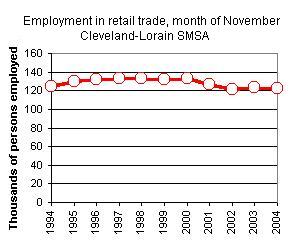
Here's a chart of total retail employment in the Cleveland-Lorain region during the last eleven years. During this period, millions of square feet of retail space were built in Cuyahoga and Lorain Counties: the South Park mall in Strongsville, Avon Commons, Legacy Village, the Promenade in Westlake, most of the Ridge Park mall in Brooklyn, etc., etc., not to mention a half-dozen Wal-Marts, another half-dozen Targets, chain drugstores on every corner and many specialty big-boxes. So look at the resulting employment change:

Source: U.S. Bureau of Labor Statistics


Not what you'd call a robust growth picture, eh?

Retail employment doesn't grow when developers build more stores, it just moves around. This is especially true when the region's retail space is already overbuilt, as ours is, according to the County Planning Department's Northeast Ohio Regional Retail Analysis.

If eighteen hundred people get hired at Steelyard Commons, that will simply mean that a similar number of jobs are lost somewhere else in the area. And it's a sure bet that many will be lost to Cleveland residents, over 15,000 of whom already work in city or suburban retail establishments.

So please, can we stop talking about "creating 1,800 jobs" in Steelyard Commons? It isn't exactly a lie, but it's even farther from being a meaningful truth.

5.22.2005

WAL-MART DEBATE ON WCPN MONDAY: WCPN's "90.3 at 9" will have a debate on the Wal-Mart issue this Monday between Ward 13 Councilman Joe Cimperman and Chris Ronayne, Mayor Campbell's Chief of Staff. The program is live from 9 to 10 am at 90.3 on your FM dial.

The call-in number is 216-578-0903.
a

5.21.2005

PUTTING SOME ACTUAL THOUGHT INTO DEVELOPMENT: Brewed Fresh Daily has posted the full text of an email sent around yesterday by Brian Cummins, the Ward 15 City Council candidate who just resigned as director of Old Brooklyn Community Development Corporation. Brian was one of the few voices asking for some serious discussion of Steelyard Commons when the project was was being waved through the regulatory checkpoints by City Hall last year.

Note carefully Brian's point about what the famous "retail leakage" study actually recommended, as well as County planners' derailed effort to devise a sustainable development plan for the valley. Then you'll want to take a look at the Cuyahoga Valley Initiative's website and the study done last year for the CVI by the Rocky Mountain Institute.

Do you see any strategic basis in there for fast-tracking a plan to cover 130 key riverside acres with a 4,500-space parking lot and a million square feet of cookie-cutter retail?

Me, neither.
a

5.20.2005

AND ONE MORE PLAIN DEALER QUESTION...

Why is it that the PD always refers to guys who runs big corporations and have the power to unilaterally order thousands of employees around as "business leaders"...

while someone who holds elective office in a federation of independent labor organizations, directing a handful of subordinate staff, is routinely described as a "labor boss"?

Just wondering.
a
CLEVELAND BLOGGERS ORGANIZING AGAINST STEELYARD COMMONS WAL-MART

From Democracy Guy:
As we discussed at our bloggers/podcast meetup last night, the first No Cleveland Walmart organizational meeting has been scheduled...

Wednesday, May 25, 7pm, at the Treehouse. 820 College Ave. Corner of College & Professor in Tremont.

Bring friends. Spread the word on your blogs & podcasts. We're hoping to have a website up by then, some concrete plans, and we'll be brainstorming at the meeting for more ideas. Grassroots, baby.
STEELYARD COMMONS PROPERTY TAXES SPOKEN FOR?

When the Mayor talks about "$3 million in new taxes" from Steelyard Commons, we're supposed to get an image of teachers and policemen returning to work. But look what I just stumbled upon in Trails and Tracks, the Ohio Canal Corridor newsletter (see the Spring 2005 edition, page 9):
Ohio Canal Corridor has been negotiating with the city to design a Tax Increment Financing (TIF) District that includes Steelyard Commons and follows the routing of the Towpath Trail from lower Harvard Avenue towards Canal Basin Park. Such a District would allow for the enhanced value of the property taxes for Steelyard Commons to be directed to underwriting bonds that would provide local funding dollars for the Towpath project. These local funds would, in turn, be used as leverage (local match) for federal transportation funds for trail development. In other words, the single biggest question to building the Towpath -- where to find local match -- would be solved!

Needless to say, this idea is currently on HOLD. Like the development from which it would benefit, the TIF is in jeopardy. In fact, recent discussions with key administrative officials concerning Steelyard Commons suggest that the city will attempt to save the deal by directing TIF financing to Mitch Schneider to underwrite portions of the infrastructure he would have provided gratis. Let us hope that our civic leaders come together to salvage Steelyard Commons so it can move forward in a manner that yet allows a TIF for the Towpath. If not, it will be a rare opportunity squandered
"TIF" is a development tax subsidy that's a second cousin to tax abatement. The developer/property owner has to pay the regular tax rate on the new value created by the development, but the revenue doesn't go to schools and city services -- it gets diverted into a special fund for "public enhancements" to the project itself.

I cannot remember ever seeing a reference to a TIF District in all the reporting about the Steelyard project. Can you?
a
NAMING NAMES


The gentleman pictured above is Brent Larkin, the editorial page editor of the Cleveland Plain Dealer. In this capacity, he wrote the unsigned editorial in yesterday's paper entitled "Supersurprise". This link is to a copy of the editorial, because access from cleveland.com will disappear after a couple of months, and I think it's important for this particular piece to be remembered... along with the individual who wrote it.

I've made this copy only for "fair use", of course. What use could be fairer than to file it away -- with Larkin's name written across it in big red letters -- to be pulled out and passed around in a year or two, when more neighborhood groceries are closing (like, let's say, the Dave's at Arbor Park) and people are looking for someone to blame?
Plain Dealer reporter: "Mrs. Jones, how do you feel about losing your local grocery store and who do you think is responsible?"

Neighbor on the street: "I'm really upset and I blame your newspaper, especially Brent Larkin. Here's this editorial where he beat up City Council to get Wal-Mart selling groceries down in the Flats, even though he admitted it would 'surely hurt some city merchants, including grocery stores'. What he meant was my neighborhood store, so don't come around here acting sympathetic now. Your Brent Larkin and his Wal-Mart buddies closed this store!"
Perhaps you think this is too personal. Mr. Larkin is just doing his job and expressing his opinion, right?

But Larkin knows better. He understands the power of naming names.

That's why he attacked Councilman Joe Cimperman so personally in another anonymous editorial on the Wal-Mart issue in February -- the one that scared Council away from its original big box ordinance, weeks before Wal-Mart sent its letter of tactical withdrawal from Steelyard Commons. (That editorial has long since vanished down the cleveland.com memory hole, but here's my entry that described it.) And it's why he made a point of clubbing Cimperman personally again yesterday... not just for proposing a law to limit big box grocery sales in the first place, but for "ineptly" failing to pursue it once Wal-Mart no longer seemed to be in the picture.

The idea, you see, is not just to argue and win a debate, but to identify, isolate and discredit your opponent. Make em crawl. Control the narrative. That's the kind of power that counts.

Of course this is not the rational, decent citizen's idea of a democratic community debate. And contrary to media wisdom, the real community debate about a Steelyard Commons Wal-Mart is not over. It may really have just started. Yesterday's editorial may someday seem like a nasty little yelp in the darkness before the dawn.

But keep a copy anyway. And remember who wrote it.

P.S. Brian Cummins emailed me to point out that older PD articles can be accessed through the Plain Dealer database of the Cleveland Public Library. Here's the database link for the February editorial I mentioned above. You'll need a local library card (CPL itself, or a cooperating system like Cuyahoga County).
a

5.18.2005

DEMOCRACY GUY ON STEELYARD COMMONS: Here, here, and here.

What he said.
a

5.17.2005

BLOGGER'S BLOCK: I don't know why I haven't gotten this thing back in gear for two weeks. Strange as it may seem, there are days when I can't bring myself to bloviate, and twelve of them just showed up in a string. Maybe it was the weather. Or allergies. Or a rare attack of good sense. Whatever it was, I think it's over.

And just in time, because...

THEY'RE BAAAAAACK! aWal-Mart, that is. Channels 3 and 5 are running the news that Steelyard Commons, aka Wal-Mart Commons, aka Schneider's Folly, is back on track with a full-service SuperCenter in the anchor slot. Here's Channel 5:
The retail giant agreed Tuesday to do the project in a proposal that does not require City Council approval.

Council Member Joe Cimperman accused Mayor Jane Campbell of sidestepping council.

"The mayor has shown that she would rather go around and do stuff under the cloak of secrecy instead of an open trusting relationship," said Cimperman.

But Campbell's chief of staff Chris Ronayne said this is not the case.

"What the developer always said to us: 'I have the zoning. I have the money. I have a plan. Work with me. And please don't stand in the way of retail opportunities in the city of Cleveland,'" said Ronayne.

Wal-Mart was brought back to the table with the assurance that it would be able to operate a grocery store alongside its retail business.
So, let's review some things we've learned in the last three months:

1. There was never a Steelyard Commons plan that didn't include Wal-Mart.

2. Wal-Mart was never going to put an anchor store in Steelyard Commons without a grocery operation.

3. Therefore, there was never a plan for Steelyard Commons that didn't depend on sucking spending and jobs out of unionized grocery stores in other Cleveland neighborhoods.

4. The Mayor either knew this all along, or got rolled. In either case, she's now in a position to take full, uncontested credit for the whole thing. She now gets to run for re-election as the Wal-Mart Mayor.

5. Be careful what you wish for, because you might get it.
a

5.04.2005

NO SURPRISES: Thanks to everyone who answered the call and wrote a comment on my last post, while I was down South enjoying a real Spring and some real music. Doc and his friends put on quite a show. Where else could you see 82,000 people show up for a community college fundraiser?

And you know, Wilkesboro doesn't even have a convention center. Go figure.

Anyway, guys, thanks for the comments and don't take this the wrong way, but the first rule of essay tests is "Read the question carefully".

I asked: "What's going to be the biggest issue in the 2005 Cleveland Mayor's race that nobody's talking about... yet?"

You answered: Race. Jobs. Poverty. Regionalism. The lakefront. Too many council members. Who's got a vision.

You think these are "issues that nobody's talking about"? Hmmmm. People, you gotta get out more.

Steve Fitzgerald came closest to a qualifying answer with his nervous prediction of a "corruption" issue. It's true, no one is currently accusing any of our mayoral candidates of theft, bribery or being in Nate Gray's wedding party. But Steve, this would be a more satisfying proposition if it had a little more, um, meat on it, don't you think? Do you have something you'd like to share with the class?

Otherwise, if you all are right, this is going to be a really unsurprising campaign.

Oh well. On Saturday I learned that three country boys I'd watched in the public picking area Friday night, joshing with the Wilkes County EMS crew while playing bluegrass standards at heartstopping speeds, were really a headlining band from... Switzerland. Maybe that just used up my quota of surprises for the week.

(Thanks to Clevelander for the tip about Frank Jackson's new website.)
A

4.27.2005

TAKE MY BLOG, PLEASE: Sorry the posting's been sparse lately. It's been a week full of other things to think about. And in the morning we're hittin the highway for Merlefest, where I expect to be alienated from the means of blog production for a few more days.

But hey, look, there's a "comments" link down there! Why don't you try doing some work for a change? Here's a topic to get you started:

What's going to be the biggest issue in the 2005 Cleveland Mayor's race that nobody's talking about... yet?

A

4.26.2005

NEW YORK CITY LOOKS INTO AFFORDABLE BROADBAND FOR ALL

New from MuniWireless:
New York City Council Member Gale Brewer has introduced legislation that would create a nine-member task force charged with ensuring that every city resident, small business, and non-profit has affordable broadband access.
There's 2004 polling data showing that fewer than 40% of Cleveland homes have Internet service of any kind, and only about one in ten has a DSL or cable-modem connection.

In Philadelphia, Chicago, Minneapolis, San Francisco, Houston, and now New York, city governments and their nonprofit partners have begun to confront the Internet gaps holding back their citizens and economies. When will Cleveland get around to it?
A

4.17.2005

LA TIMES ON OHIO PERS AS A "MODEL" FOR SOCIAL SECURITY

In an article yesterday by Peter G. Gosselin and Edwin Chen:
KIRTLAND, Ohio — President Bush came to Ohio on Friday to highlight a state retirement savings system that he said showed that Americans would be better off handling their own old-age investments through personal accounts than relying on traditional Social Security.

But that state's version of personal accounts has attracted few takers among the people eligible — Ohio's 750,000 public employees. And records show that the most widely chosen version of the state-offered accounts has racked up a five-year earning record of 1.86%, about the same return that the president says Social Security produces.

"Boy, does he have a hard sell ahead of him in using Ohio as his example," said Keith Brainard, research director of the National Assn. of State Retirement Directors, which represents virtually all of the nation's public employee pension plans.
Thanks again, HS.
A
OHIO TALIBAN UPDATE: Fifteen members of the Ohio House of Representatives have found time in their demanding schedules to introduce House Bill 184, "A bill to amend section 3314.03 and to enact section 3313.801 of the Revised Code to require school districts and community schools that receive donated copies of the mottoes of the United States of America or the State of Ohio to display the mottoes in school buildings."

Here's the proposed new state law:
Sec. 3313.801. If a reasonably sized copy of the official motto of the United States of America "In God We Trust" or the official motto of Ohio "With God, All Things Are Possible" is donated to any school district, or if money is donated to the district specifically for the purpose of purchasing such material, the board of education of the school district shall accept the donation and display the motto in an appropriate manner in a classroom, auditorium, or cafeteria of a school building in the district.
As introduced, the bill does not cover donations of reasonably sized copies of the Great Seal of the United States (adopted 168 years before the U.S. Motto) or pictures of the Ohio state bird (the cardinal), tree (buckeye), or flower (carnation), all of which predate the General Assembly's adoption of the state motto in 1959. Nor does the bill require schools to accept and display framed copies of the Bill of Rights. But perhaps we'll see some additions in committee.

(Want to stay up to date on the many interesting things our legislature is doing? Here you go.)
A

4.14.2005

"OUT OF CONTROL": A very important post from MaryBeth Matthews.
A
BAMBOOZLEPALOOZA PLAYS LAKE COUNTY: President Bush's "Social Security reform" road show, affectionately nicknamed "Bamboozlepalooza" by Josh Marshall, rolls into Lakeland Community College in Kirtland tomorrow at 1:50. As with earlier stops on the 60-day tour, this "educational" event on public property is open by invitation only, i.e. only to ticketed Bush supporters bearing friendly questions. All others will be kept far away.

Why Kirtland? That's easy. Congressman Steve LaTourette, who once endorsed private accounts, has been vewy, vewy quiet about the whole issue lately. (Here's the "Steve's Issues" page on his website -- notice what isn't there.). Both of Ohio's Republican Senators recently broke ranks with the party to vote against the Bush budget, and Mike Dewine -- up for re-election in 2006 -- has expressed enough doubts about the Bush Social Security plan to earn a place in Marshall's "Conscience Caucus".

So the President's got some slippage problems in our neighborhood. Will tomorrow's stage-managed "round table" help? Bamboozlepalooza's results in many other places have been disappointing, to put it mildly (see a day-by-day summary from the Congressional Democrats here). Will LaTourette, Voinovich or Dewine even be there to greet their leader? We'll find out tomorrow.

Meanwhile, if you want to know what kind of welcome the opponents of Social Security privatization are planning, give a call to John Gallo at the Cleveland AFL-CIO, who staffs the local Coalition to Protect Social Security (no website yet, but it's in the works). Or check out Hypothetically Speaking's post about Americans United to Protect Social Security.

If you want to attend Bamboozlepalooza Kirtland and ask your President a question, I'm not sure what to tell you. I guess you could call your county Republican Party office and ask if any tickets are available. Um, yeah, that might work.

UPDATE: (from Hypothetically Speaking)
Privatization rally in Cleveland Friday

The Ohio branch of Americans United to Protect Social Security says it will be holding a rally Friday, April 15 at 10 AM. Speaking at the rally will be Massachusettts Congressman Rich Neal (MA-2). The rally is to be at Voinovich Park, located directly behind theRock and Roll Hall of Fame at E. 9th Street and the Lakefront, Cleveland, OH.

Questions? Call Tom Powell-Bullock 440-554-7203.

4.12.2005

MOMENT OF TRUTH FOR COMMUNITY DEVELOPMENT BLOCK GRANT

A Congressional conference committee will decide in the next couple of days whether to kill the Community Development Block Grant program, the major source of funds for neighborhood housing and commercial development in Cleveland and other cities throughout Ohio.

Cleveland's stake in this decision is almost $30 million a year.

The House of Representatives has voted to kill the program outright, as proposed by the Bush Administration. The Senate voted 68 to 31 to preserve it, over the strenuous objections of the Republican leadership. A conference committee is meeting this week to resolve this and other disagreements between the two houses and produce a "compromise" budget, which will then go back to the House and Senate for up-or-down votes.

Here's an excellent summary of this week's legislative situation from BushBudget.org.

Both Voinovich and Dewine were among the 24 GOP Senators who joined with Democrats to preserve CDBG. More impressively, Ohio's Senators then joined with just two other Republicans and all the Senate Democrats to vote against the full budget resolution, which passed by a vote of just 51 to 49.

Voinovich has been especially vocal in support of CDBG. This is great, but now comes the moment of truth. Ohio's Senators need to use every ounce of "juice" they have, publicly and privately, to get their leadership and the Senate's conferees to respect the clear majority mandate of their colleagues and keep full CDBG funding in the final conference committee budget.

Let Voinovich and Dewine know you appreciate their support for CDBG and expect them to keep it up! E-mail is probably not the best way to communicate about this issue. A telegram to the Senator's D.C. office is the best way to get somebody's attention, but a fax or phone call is good, too.
Senator Michael Dewine
140 Russell Senate Office Building
Washington, DC 20510-3503
Phone: 202-224-2315
Fax: 202-224-6519

Senator George Voinovich
317 Hart Senate Office Building
Washington, DC 20510-3504
Phone: 202-224-3353
TollFree: 800-205-OHIO (OH only)
Fax: 202-228-1382

4.11.2005

JOHN KROLL SCORES AGAIN! Did you ever think you'd see the word "exploitation" on the PD business page?

If your appetite for unexpected papal economic thought has been whetted, I strongly recommend this from MaxSpeak and this from Nathan Newman. Or you can just read Laborem Exercens.
A
DEPARTMENT OF COUNTER-INTUITIVE STATISTICS: Yesterday Don Iannone linked to this chart in the March edition of Site Selection. It's a state-by-state comparison of new corporate facility locations and expansions from 2002 through 2004. Guess which state ranked...
-- fourth in location of new manufacturing facilities (256 projects)
-- first in manufacturing facility expansions (714 projects), and
-- fifth in location of other new corporate facilities ("offices, headquarters, distribution centers, research and development facilities, speculative offices, speculative industrial buildings, mixed-use facilities and hotels" -- 879 projects)?
Why, yes, it's Ohio... the same state that lost 60,000 jobs over those same three years (December 2001 to December 2004) while the nation was adding nearly 1.7 million.

So contrary to what we keep hearing about our "unfriendly business climate", Ohio actually seems to have been very attractive to corporate decision-makers compared to other states. Gee, they can't be all that worried about our tax system, can they?

Yet we remain at the bottom of the heap in net job creation. Very mysterious.
A

4.10.2005

TRIOZZI, TOO: Okay, so now it turns out that Robert Triozzi has a campaign website, too... even more "under development" than Draper's, but here it is. And there's a Triozzi Meetup group (two, actually). Thanks, John.

I'm officially encouraged. Now my question is when either of these sites will have some specifics about what the candidate will do if he gets elected.
A
JIM DRAPER DOES HAVE A WEBSITE: Via a comment from Mike on this post, my question "Where's his website?" is answered for mayoral candidate Jim Draper: He's got one and here it is. The posting date is March 24, the same day Jim announced.

I still can't make it show up on Google, and this might be the site's first link. But it's out there and it's got contact info, press links and at least the beginning of program information. So... good for candidate Draper. And thanks, Mike.
A

4.09.2005

DEPARTMENT OF CHECKING THINGS OUT: Wired News has this piece on an Australian inventor and a California startup that are trying to commercialize a high-altitude wind power technology. "High altitude" means waaay up there -- three miles or more -- and the technology involves turbines mounted on tethered rotorcraft. The inventor has patented and successfully prototyped his design (see picture below) at low altitudes. But he and the company (Sky Windpower, headed by a guy named David Shepard, who made his original pile in the '50s as an inventor of Optical Character Recognition scanners) have been unable to raise $3 million to stage high altitude tests.


I heard about this outfit by accident a couple of years ago and exchanged emails with Shepard, who wondered if I knew anyone around here with money. (Ha ha.) It struck me then, and still does, as an idea that ought to interest Cleveland techbiz promoters. Cleveland, after all, is in a very high-cost power market, is at a very high-potential latitude (41.5 degrees north) according to Dr. Caldeira's charts, has a big lake over which you could fly these things, and has great local expertise in power technologies and aerospace at NASA Glenn -- soon to be seriously underutilitized.

It just seems like something that should be checked out by somebody in Northeast Ohio with an appropriate knowledge of engineering.

At the time I asked Holly Harlan of Entrepreneurs for Sustainability if she had any ideas, but she drew a blank. Then last September I had a conversation about it with Bill Spratley of Green Energy Ohio, and sent him Sky Windpower's link. I haven't heard anything more from Bill.

Since the story is now in Wired -- and Sky Windpower is apparently still looking for investors -- let me give it another try. This might be a great opportunity for the region to get a piece of a breakthrough technology. Or, of course, it might be totally bogus. But shouldn't somebody from NEO with appropriate expertise and connections take a look at this possibility, while it's still parked on the ground floor?

Who might that be?

If it's you, please leave a comment or email me and I'll send you everything I've got on the subject.
A

4.08.2005

PHILADELPHIA RELEASES BUSINESS PLAN FOR CITYWIDE WIRELESS SYSTEM

Mayor John Street held the press conference yesterday. You can download the full business plan here.

As expected, the system will be run by a nonprofit corporation and designed and built by private vendors. But the big news is open, competitive ISP access to the infrastructure. From the press release:
The Committee’s report made the following key recommendations:

Create a nonprofit corporation to manage the deployment of the wireless network - The Committee recommended a non-profit corporation be established to oversee the implementation of the proposal. The non-profit will receive its start-up funding from foundation grants, bank loans and other non-city sources. Within four years, the non-profit is projected to be debt free and generating positive cash flow.

Have private companies design, deploy and manage the network - Through a request for proposal (RFP) process, the non-profit will outsource the design, deployment and management of a citywide wireless network.

Provide network access to private service providers at low wholesale prices - The non-profit will make access to the wireless network available to private Service Providers (SPs), institutions and other nonprofits at low wholesale prices. Individuals and businesses will be able to purchase broadband access from these parties at what had been dial-up prices. There are currently at least 430 dial-up Internet service providers who operate in Philadelphia. SP’s will be responsible for marketing the service, billing subscribers and providing customer service and technical support.
P.S. MuniWireless has an interview with Philadelphia tech czar Dianah Neff about the plan.
A
CAMPAIGNING LIKE IT'S 1995: Frank Jackson had a campaign kickoff rally yesterday. The Plain Dealer says he "outlined the general themes of his campaign: improving the schools, fostering economic development and job creation, reforming City Hall and increasing public safety."

I'm in favor of all these "themes", of course. As is the current mayor. As are Jim Draper and Robert Triozzi... and, I assume, Anthony Brown.

The question for the next six months is what they plan to do about any of these "themes" that's different from what's already being done. And why they're better able to get it done than the other candidates. And why it will make a big enough difference in our lives that voters should care.

If this city should have learned anything at all in the past twenty years, it's that high-sounding phraseology about schools, jobs and safety -- or entrepreneurship, or neighborhoods, or poverty, or [insert theme here] -- is, in itself, worthless. Dude, we know what the problems are. How exactly do you propose to solve them?

Twenty or even ten years ago, it was normal for citizens to wait for answers to these questions until the campaign mail started arriving, or we could get to a candidate's night. Candidates would spend the first few months of their campaigns looking for money and endorsements, building name recognition, and quietly testing specific issues and messages for later use.

But this is not ten years ago. It's 2005, and we have something called the World Wide Web. When a candidate says he's going to do something about an issue we care about, we don't say to ourselves: "That sounds good, I'll have to check him out some time." We say: "Where's his website?"

Frank Jackson first announced his candidacy in January. Where's his website?

Jim Draper announced two weeks ago. Where's his website?

Judge Triozzi announced at the beginning of this week. Where's his website?

Mayor Campbell doesn't have a campaign site either. But she does have a lot of specific issue and program stuff linked from the main page of www.city.cleveland.oh.us -- full texts of her last two State of the City speeches, for example, not to mention a lot of press releases. Indeed, the city website is pretty much the Mayor's personal homepage. Most mayors do the same thing... look at Philadelphia or Chicago. This doesn't make the practice right, of course -- but right or wrong, it means you can find reasonably current information about Campbell's positions and proposals on line.

Jackson, to his credit, hasn't treated the City Council website as his personal property. In its own way it's a better site than the Mayor's, if you're looking for easy access to useful information -- like how to reach your Councilman, who's on what committee, or what happened at the last Council meeting. But it isn't going to help a voter to figure out what Frank Jackson would do if he becomes mayor.

You may think it's a little early in the campaign season to expect the candidates to have Web presences, especially in Cleveland, where so many voters are on the wrong side of the digital divide. I suspect this is how the candidates and their managers see it.

If so, they're wrong. The rules have changed. There's recent survey data showing that nearly half of Cleveland adults are regular Internet users, and the percentages are much higher for those who are better educated and/or better off (i.e. likely voters). At least in part, this City election is going to be fought under the new Internet-driven rules: immediacy, transparency, interactivity, decentralized initiative. A campaign that launches without the capacity to put its press releases on line, or a public email address, doesn't demonstrate much aptitude for this new environment.

IMHO, there's a strong case to be made for the following proposition: In 2005, a person who can't demonstrate an excellent personal command of basic Internet applications is not qualified to be the mayor of a major city. It's just part of the job description for a 21st century leader.

The campaign is a job readiness test. And the exam is now in progress.
A

4.06.2005

SCHEDULING A SCHOOL LEVY: Mayor Campbell says she and her school board plan to put a school levy on the ballot in October or November, i.e. on the city's primary or general election day. Campbell's main rival for mayor, Council President Frank Jackson, has attacked her for waiting too long; he wants an August levy vote.
At last night's school board meeting, several City Council Members (Zack Reed, Joe Cimperman, Kevin Conwell) and others including Rev. C. J. Matthews of the Cleveland SCLC chapter called on the board to hold the vote during the summer and said they're ready to campaign for it. Schools CEO Byrd-Bennett responded that she'd take it up with the mayor on Friday.

From a cynical electoral point of view, it's obvious why Jackson wants the levy out of the way early. If it's on the November or even the October ballot, he can't attack Campbell on schools issues without appearing to undermine the levy, while all the sunny campaign messages about the schools can only benefit the incumbent mayor. But an August vote would at least neutralize the issue -- and a second levy defeat, which is highly likely, would give Jackson a big stick to beat Campbell with among minority voters, parents and corporate donors.

Is Frank Jackson calculating this cynically? Is the Mayor? How about the Councilmen and ministers at the School Board last night (who looked to me like a pretty pro-Jackson bunch)? Yes, yes, and I don't know but it wouldn't startle me.

Okay, but what about those who really just want to get a levy passed? Isn't this so urgent that we should get it on the ballot as soon as possible? And wouldn't Campbell's best possible move be to challenge everyone -- Jackson, Triozzi, Draper, all the Councilmen -- to put City Hall politics aside for four months and join in a united campaign to save the schools?

Yes, this would make perfect sense... if the Mayor thought she had any chance of winning such a vote. Conventional analysis says, however, that a levy's chances of passage in August are slim to none. Two important reasons:
  • Low turnout. School taxes generally do better in high-turnout elections, which include more African-American and Hispanic voters, more low-income voters generally, a higher proportion of tenants, etc. There will be this kind of turnout in November, and a smaller version of it in October. But a special vote in August will be tiny, drawing only the likeliest of likely voters (i.e. older, homeowning, middle-class non-parents). Of course, if the school forces could mount a really successful turnout drive among low-income parents, they could turn this logic inside out (small general turnout + big parent turnout = win for parents). But that's a huge "if", especially considering that...

  • In the summer, schools are closed and teachers are on vacation. A big get-out-the-vote campaign for a levy, especially in a low-visibility single-issue election, takes a massive hands-on volunteer effort. The absolute worst time to attempt this is July and early August, when the schools' day-to-day connection with families is broken, and teachers are scattered to their vacations and summer jobs. Again, this conventional logic could be inverted; hundreds of teachers could agree to devote their vacations to full-time campaigning, and the maintenance unions could agree to keep the schools open for the campaign at no cost. (Hey, how about a free summer program for kids sponsored by the levy campaign? Boy, that would get parents' attention!) But this would entail an unprecedented level of innovation, collaboration, and personal commitment -- not something the Mayor has any reason to rely on, especially this year.
So while there's a way to win in August, it's a long shot. And if it loses, that's it... there's no way to try again in November. The Mayor's plan of holding off until the city elections appears, from this outsider's vantage point, to be a lot more prudent.

But having said that, if I were Campbell or Byrd-Bennett, I'd still be taking a hard look at August scenarios. And I'd be asking some hard questions, as suggested above: Is Frank Jackson actually willing to suspend mayor's-race hostilities for four months, and unite behind a levy campaign? Could we get five hundred or more CFT members to volunteer their summers to campaign door-to-door? Could we get a full-bore campaign effort from other unions, and the funds we need from the business community? Can we find some trusted campaign management -- with no axe to grind in the mayor's race -- to put this all together in a few weeks?

If all these questions turn out to have positive answers, an August levy effort might be worth a shot. Otherwise, it's just smoke and mirrors... mayoral politics by other means.
A

3.31.2005

YES, THE CLEVELAND SCHOOLS REALLY ARE GRADUATING MORE KIDS: Back in October this blog broke the story of the Cleveland School District's claim of a dramatically improved 2004 graduation rate of almost 50%.

Okay, I didn't actually "break" it, since nobody else noticed. The story didn't reach the real media until March 16, after schools CEO Byrd-Bennett made a presentation about it to the School Board. First the PD ran a story. Then a couple of TV stations picked it up. Then the PD ran an editorial expressing a lot of skepticism. Then they ran an op-ed by "school choice" promoter Jay Greene of the conservative Manhattan Institute, who said he was skeptical at first but now realized the District's new numbers were probably legitimate, and the graduation rate had shot up from 28% in 1998 as a result of competition from private charter schools and vouchers. Then the District's former research chief, Peter Robertson, wrote a letter to the editor in which he said:
For years, the Cleveland schools have been explaining that the "real" graduation rate was about 50 percent, not the 28 percent figure Manhattan Institute researcher Jay Greene made up. We explained repeatedly that we had historical dropout reporting problems and that it would take about four years for the official numbers to reflect our corrected reporting... The press never bought the district's explanations and always gave air time to Greene's uninformed disbelief.
(Mr. Robertson didn't explain why Byrd-Bennett herself keeps repeating Mr. Greene's "made-up" 28% figure -- for example, in the the District press release linked above -- but let's not complicate this story unduly.)

So, are you confused enough yet?

Well, forget the percentages. There's a much simpler measure of the schools' outcomes -- the actual number of kids who are getting diplomas. And by that measure, it's undeniable that something very hopeful has happened recently.

From the District's Office of External Affairs, here are the numbers of kids who actually graduated over the last seven years:
1,741 in 1998
2,050 in 1999
1,700 in 2000
1,881 in 2001
2,205 in 2002
2,614 in 2003
2,508 in 2004
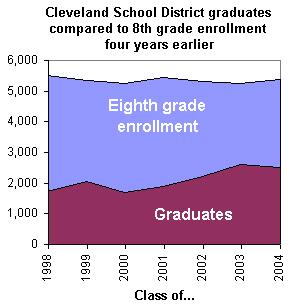
And here are those numbers graphed against the number of kids enrolled in the eighth grade four years earlier (my own dumbed-down version of the graduation rate):


As you can see, the number of eighth graders in each class varied very little, while the number of graduates four years later has changed significantly. From 1998 through 2001 (Byrd-Bennett's first four years on the job) the District graduated an average of only 1,843 seniors. In the past three years, this average has jumped to 2,442... an increase of six hundred graduates annually! (If you just gotta have percentages, that's a 33% improvement.)

Clearly, something important is happening in Cleveland's public high schools, and it's not just improved record-keeping. The Manhattan Institute, inevitably, says it's competition from private schools. The CEO says it's "a conversion to small schools..., targeted assistance for students for the Ohio Graduation Test and proficiency tests, [and] credit-recovery programs (including twilight and extended day programs)". Cool Cleveland says we shouldn't forget "strong leadership provided by schools CEO Barbara Byrd-Bennett, and Mayoral control of the school board which eliminated political posturing."

Who's right? Maybe they all are. Or maybe we're just seeing the sum of a lot of small successes by a lot of different groups and individuals -- mentoring and tutoring, technology programs, entrepreneurship groups, college prep and scholarship programs, etc., etc. Or maybe it's something else entirely -- something in the city's culture or demographics that nobody's recognized yet.

But whoever shares in the credit, something is working -- something that we all need to understand better so we can help keep it going.
A

3.25.2005

"OHIO'S JOB PICTURE REMAINS BLEARY": Policy Matters Ohio has posted the March 2005 edition of its Job Watch.
Ohio’s job picture remains bleary, as the state has lost jobs during five out of the last six months. According to the latest seasonally adjusted payroll numbers issued March 18 by the Ohio Department of Job and Family Services, the state lost more than 4,000 nonagricultural jobs in the last month, leaving it with 188,000 or 3.4 percent fewer jobs than it had when the recession officially began in March 2001.

3.24.2005

SPRINGER ON (MY) RADIO: I have a dirty little secret. For years, I've had a button on my car radio pre-set to 1100 AM. And it's not for basketball games (IMHO, listening to a ball game is like smelling an art exhibit).

No, the truth is that many times in the last decade or so I've driven around listening to Trivosonno. And to Rush. And to the endless roster of second-string dimbulbs that Clear Channel keeps parading across its local bandwidth to pontificate on sports and politics -- apparently aimed solely at a demographic of Republican insurance salesmen driving to suburban sports bars.

Who knows why do I do this to myself? I used to think of it as political anthropology, or a brave scouting trip into enemy territory. More recently I'm facing the fact that I have personal issues -- issues with silence, with almost all of what passes for music radio, with the general attitude of NPR, with the price of tapes. So I occasionally hit the WTAM button just to get some stupid noise.

As disfunctional as this habit may be (I still think it's less damaging than watching cable news), it has given me a perspective on the talk radio phenomenon. So here's a big, obvious, absolutely unsurprising insight: If you believe in market economics, it's really weird that for fifteen years all the commercial, non-morning-drive radio talkers in the Cleveland market have been outspoken conservatives.

(Yeah, I know Trivosonno used to say good things about unions occasionally, and I actually heard his brilliant rant against seat licenses when the Browns Stadium deal was announced. But that doesn't change the fact that WTAM's afternoon-evening politics is basically all Bush, all the time.)

Folks, every precinct in the city of Cleveland voted for Kerry in the last election. Cuyahoga County went for Kerry two to one, and for Tim Hagan in the last governor's race, 60%-40%. In the whole "Cleveland-Akron area" (Cuyahoga, Lorain, Lake, Medina, Geauga, Ashtabula, Summit, Portage), the liberal Democratic candidates won those two elections with 59% and 52% of the votes, respectively. Democrats dominate local elections in most of this territory. Like it or not, northeast Ohio is a bastion of liberal Democratic voters.

It's awful hard to believe there's no commercial niche for talk radio aimed at these voters as listeners. And isn't that what commercial media is supposedly all about -- competing for listeners based on our own interests, preferences and prejudices?

So, finally, Clear Channel has decided to give it a try, and we've got Springer on the Radio.

Jerry Springer is, of course, an extremely successful media guy. Like or hate the TV show, you have to admit it's a winner. It's made him rich enough to give a lot of money away, and fund his own campaigns (which makes him a viable candidate for Governor). And it isn't a fluke; Springer was a popular television figure in Cincinnati before he went national, and his new radio show reportedly leads its station's lineup after a couple of months of airtime.

But Springer's also a real, "progressive" Democratic politician. And he's more attuned to the rising Internet wing of the party than most. Take a look back at his show's homepage. Notice that it's mostly a blog. Notice that it has a real blogroll with lots of Ohio links, including one to Cleveland Diary. Notice that one of the show's "simul-bloggers" is Jesse Taylor of Pandagon, a top-ranked member of the Democrat blogocracy based in Cincinnati.

Even if you hate talk radio this is interesting, because it apparently reflects a big new turn in Clear Channel's programming strategy. WCKY, Springer's home base in Cincinnati, is a Clear Channel property that's now been shifted entirely to "liberal talk", mostly through the nationwide Air America network. And Springer himself has just joined Air America's lineup.

Will we have Air America on the air in Cleveland soon? Who knows? But since Monday, we've got Jerry, and he's certainly different from anything we've been hearing. Even if you don't have a radio button pre-set to 1100 AM, I suggest giving Springer on the Radio a listen.
A

3.18.2005

CLEVELAND PROMOTES ECONOMIC DEVELOPMENT IN RICHFIELD... and gets some income taxes in return.

Here's a City press release from Tuesday that hasn't gotten any coverage that I can find. Apparently the City of Cleveland is helping the Village of Richfield to create a Joint Economic Development District (JEDD) in Richfield Township.
The Village of Richfield and Richfield Township are in the process of creating a Joint Economic Development District (JEDD) to be located in the Township. The Township will contribute land and provide the general public services, and the Village will extend sewers and collect the income tax revenues. The City of Cleveland will extend water service to the new district through a water service agreement with the Village adjacent to the area. The City, the Township, and the Village will share equally in the net income-tax revenues that are generated.
JEDDs allow municipalities with water systems to get some tax revenue from business development in neighboring townships, without having to resort to annexation. Essentially the city offers water service and a no-annexation pledge in exchange for a share of new income taxes from the JEDD. Akron has set up four of them, described here and here.

Richfield Village gets its municipal water through a service agreement with Cleveland, so it needs Cleveland's cooperation to establish a JEDD in the adjacent township. Cleveland's saying yes, in exchange for a third of the new income tax revenue.

Hmmm. Think we can get a third of the new jobs?

Seriously, for a city like Cleveland with no unincorporated land next door, and a regional water system serving 70 communities in three counties, this "long-distance JEDD" idea probably makes a lot of sense. I wonder what the possibilities are around Brunswick. Or Twinsburg. Or Olmsted Falls.

P.S. Here's the full text of the authorizing ordinance for the Richfield JEDD, introduced in Cleveland City Council Monday. (The Mayor's press release says it already passed, but this looks like a first reading. I'm probably just missing something.) Take a look at the sponsors: Coats, White, Gordon, and... Jackson. Looks like cooperation between the Mayor and Council President is still possible.
A

3.16.2005

NEW COOL CLEVELAND: Most Cleveland-area folks who read this are already aware of Cool Cleveland, the email newsletter published weekly by Thomas Mulready. But if you're not a subscriber, I highly recommend that you check out this week's edition, especially:
The featured interview with County Treasurer (and "probably not a candidate" for Cleveland mayor) Jim Rokakis, and

Roldo Bartimole's column on Senator George Voinovich and the bankruptcy bill.

3.15.2005

THE "LAST IN EVERYTHING AMENDMENT": Another good post from Hypothetically Speaking.
A
ALL THE NEWS THAT FITS THE PARTY LINE: Over a hundred people showed up at Cleveland City Hall yesterday for a rally called by the Coalition for Responsible Development. The goal was to meet with Mayor Campbell, present a stack of petitions, and urge her to stop courting Wal-Mart as an anchor for the Steelyard Commons Development until a full economic impact study is completed.

The largest part of the crowd was union grocery store workers, but there were also members of ACORN, some church social action leaders, a couple of small business owners in addition to Dave's, and other supporters. They were hosted in City Council Chambers by Ward 17 Councilman Matt Zone while attempts were made to connect with Campbell (who was supposedly meeting with Wal-Mart executives yesterday.)

Campbell refused to see the group personally, but a delegation was able to meet with her chief of staff, Chris Ronayne.

I'm telling you all this because apparently no one else will.

The Plain Dealer, which had City Hall reporter Olivera Perkins on the scene interviewing participants, ran no story today. Channel 3, which had a camera crew there, posted a short article on its website but gave the rally no on-air coverage. There was nothing on Channel 5, 8 or 19/43.

And that's the way we do fair and balanced coverage of "the big box issue" in Cleveland.

(Since I wasn't there personally, I should tell you that my source for this original coverage is Harriet Applegate of the Cleveland AFL-CIO. Harriet says there were 150 people, but I've cautiously rounded down.)
A

3.12.2005

THE SENATORS FROM MBNA: Both of "our" Senators, DeWine (up for re-election next year) and Voinovich (not until 2010), joined a solid GOP front to turn back all amendments and pass the credit card industry's "bankruptcy reform" bill. Check here, here, here, here, and here on why this was such a horrible thing to do -- especially for two guys representing Ohio.

So why did they do it? Here are the top 1999-2004 corporate campaign money sources for DeWine and for Voinovich. Look where credit-card giant MBNA ranks on their charts, especially DeWine's. And then, of course, there's National City, and KeyCorp, and American Financial...

Any questions?

WHOSE OXLEY IS GORED 2: Hypothetically Speaking has a crazy dream...
A
STRAINING AT GNATS

So the fighting issue between mayoral candidates Jane Campbell and Frank Jackson, coming out of the 2005 budget negotiation, is 45 called-back police officers vs. 30 called-back police officers (or maybe it's 41).

Why do most voters ignore election campaigns until the last few weeks? This is why.

"Ye blind guides, which strain at a gnat, and swallow a camel." Matthew 23:24
A

3.09.2005

MUNIWIRELESS: CHICAGO LOOKS INTO CITYWIDE WI-FI
Chicago has decided to look into citywide wireless broadband. Chicago Indymedia reports that the joint session of the Committees of Finance and Economic, Capital & Technology Development passed a resolution to conduct a study on the deployment of a citywide high-speed wireless network. The city's CIO, Chris O'Brien, estimates that the study will take sixty to ninety days to complete.

3.08.2005

"1800 PERMANENT JOBS": By now, if you live in the Cleveland media market you've heard it a hundred times: "Steelyard Commons would create 1,800 permanent jobs." This is the killer argument, the reason no sane community leader should do anything that might jeopardize the project.

But it doesn't have much to do with reality.

Let's assume that the new mall is built as projected, with five big-box stores (including an expandable Wal-Mart) and several dozen smaller spaces in adjacent strips. And let's assume the vacancy rate is low and the stores are very successful (you'll notice we're doing a whole lot of assuming). And finally, let's assume that the resulting work force is, indeed, around 1,800 people.

Does this mean we've "created" 1,800 new jobs? No, and here's why: New retail floor space doesn't create new retail jobs. Higher retail sales, i.e. more consumer spending, is what creates new jobs (sometimes). And since building a mall in the Flats will have no effect on the amount of money Cleveland-area consumers spend -- only on where we spend it -- it will result in little or no new job creation.

Here's a chart of total retail employment in the Cleveland-Lorain region during the last eleven years. During this period, millions of square feet of retail space were built in Cuyahoga and Lorain Counties: the South Park mall in Strongsville, Avon Commons, Legacy Village, the Promenade in Westlake, most of the Ridge Park mall in Brooklyn, etc., etc., not to mention a half-dozen Wal-Marts, another half-dozen Targets, chain drugstores on every corner and many specialty big-boxes. So look at the resulting employment change:

Source: U.S. Bureau of Labor Statistics


Not what you'd call a robust growth picture, eh?

Retail employment doesn't grow when developers build more stores, it just moves around. This is especially true when the region's retail space is already overbuilt, as ours is, according to the County Planning Department's Northeast Ohio Regional Retail Analysis.

If eighteen hundred people get hired at Steelyard Commons, that will simply mean that a similar number of jobs are lost somewhere else in the area. And it's a sure bet that many will be lost to Cleveland residents, over 15,000 of whom already work in city or suburban retail establishments.

So please, can we stop talking about "creating 1,800 jobs" in Steelyard Commons? It isn't exactly a lie, but it's even farther from being a meaningful truth.
A

3.07.2005

AS IF WE DIDN'T HAVE ENOUGH TO WORRY ABOUT... SENATE BANKRUPTCY BILL UP FOR A VOTE TOMORROW: Josh Marshall's Talking Points Memo now has a special page devoted to the Federal "bankruptcy reform" bill, up for a Senate vote tomorrow. To get an idea how this godawful bill will affect poor and unemployed Ohioans, see Policy Matters' new study on Ohio's skyrocketing bankruptcy rates.

Please, while you're contacting DeWine and Voinovich about the CDBG budget, be sure to ask them about their positions on this monstrosity too.

(This is not a liberal/conservative dispute; "bankruptcy reform" is a bipartisan monster. If you don't believe me, ask Instapundit.)

Update: Exile on Main Street links to a "letter writing machine" on the bankruptcy bill... and to a revealing LA Times article on the issue.
A
SOCIAL SECURITY: WHOSE OXLEY IS GORED

Hypothetically Speaking has two sharp posts (here and here) about Ohio Fourth District Congressman Michael Oxley, who has a lot to say about "Social Security reform" -- when he's not talking to his own constituents.
A
CITY INCOME TAX GIVE-BACK FOR NEW DOWNTOWN JOBS? The PD has a story this morning about Mayor Campbell's proposal to create a city income tax rebate program for companies that create new jobs in Cleveland's "Central Business District". I've posted the full text of the proposed ordinance here.

Believe it or not, I actually like this idea. (I may have to turn in my Urban Populist card, but what the heck, it's getting dog-eared anyway.) There are reasonable questions raised in the PD story -- why just downtown? why not target the incentive to jobs for city residents? -- but the concept is very interesting for at least four reasons:
First, it's a straightforward cash subsidy for actual hiring and payroll, not for real estate development that might lead to hiring.

Second, it leaves very little to chance. The City gets its new income tax money up front, and only then rebates a portion of it. (And the City's playing with its own money, not someone else's.)

Third, it's useful to any kind of employer. It's obviously designed for "intellectual asset" businesses, in line with the Euclid Tech Corridor idea, but would apply just as well to a cleaning contractor or bank.

Finally, it sets an excellent precedent by putting the Fair Employment Wage requirement right up front.
The PD story says Council hasn't moved on the proposal, implying that it's being stalled. Maybe this is the case, but it's just as likely that Council is waiting for formal comments from the Finance and Economic Development Departments. Besides, the Mayor and Council are still in the midst of a tense budget process. And interesting as the concept may be, it is a major innovation that calls for serious deliberation, not election year fast-tracking.

But it's a good enough idea to get that serious look from Council before Summer recess and the onset of election-year paralysis.
A

3.06.2005

CRUNCH TIME FOR COMMUNITY DEVELOPMENT BLOCK GRANT: Just got this email from Ed Schwartz at the Institute for the Study of Civic Values:
At some point Monday or Tuesday (March 7th-8th) the Budget Committees in both the House and Senate will set a projected budget for the Community Development Block Grant--as well as every other program.

The difference here is that the President has eliminated the Community Development Block Grant (CDBG) entirely from his proposed budget--so unless the Congress acts to restore its budget in the Committee meetings, it will be a struggle to get it back later on.

So if we want to save the Community Development Block Grant, we need to call our representatives in the House and Senate today--Monday morning--to express our support for the program.

Letters are circulating both the Senate and the House supporting CDBG.

You can read them on the BushBudget Web Site from here: Community Development Block Grant Under Attack

55 Senators have signed a letter supporting the Block Grant.

Far fewer members of the House have signed a bi-partisan letter circulated by Rep. Barney Frank (D) and Rep. Chris Shay (R). So it becomes critical to call your Congressperson in Washington before Noon Monday (E.S.T.)

Even if you're sure your Senators and Representatives support the Community Development Block Grant, call them. They need to know that there is strong public support for this program.

If you don't know your Congressperson's Washington number, you can find it quickly from Congress.org.

Time is critical here. If we want to keep the Community Development Block Grant, we need to act today or we'll have a much tougher fight later on.
Both Ohio Senators, Mike DeWine and George Voinovich, have signed the Senate "Dear Colleague" letter. Send them a thank-you note! Here's contact info for DeWine and Voinovich.

I have no information on any Ohio Members of Congress who've signed the House letter. The only House Budget Committee member from Ohio is Republican Rob Portman of suburban Cincinnati, called "President Bush's man in the House" by the New York Times. If you live in Portman's 2nd District, or any other Republican congressional district in the state, your call tomorrow in support of CDBG is probably worth its weight in gold. You can find your CongressMember's name and contact information here at Project Vote Smart.
A

3.04.2005

ON SUBJECTS OTHER THAN WAL-MART...

Speaking of BFD, George has been hosting an interesting conversation about the Fund for Our Economic Future's planned $3 million "regional discussion". Start here, then go here, here, here and here. Be sure to read the comments.

And for all you community networking fans, check out this project just unveiled by Houston's "Technology For All" in collaboration with Rice University. (Real geeks need to look at this related journal article.) Will Reed, TFA's president and maximum leader, says he's definitely going to be in Cleveland in June for the 2005 CTCNet Annual Conference.
A
MAYOR CAMPBELL REALLY, REALLY WANTS WAL-MART: Brewed Fresh Daily picks up the latest from Crain's.
I can't believe my eyes reading this article at Crain's Cleveland Business. When the city was declared the most impoverished, did Mayor Campbell do this much? Nope. She set up a committee to address the issue, effectively delaying an action. On this one, she's going it all alone. What gives? My favorite part is, she doesn't shop at WalMart herself. I think she should have to shop only at WalMart for at least a month. I bet she's think twice about the prestige of having one in the SteelYard Commons then.
Last Thursday I heard Planning Director Bob Brown tell a community meeting in my neighborhood that "no one in the administration wants Wal-Mart". Apparently there was someone he didn't ask.
A

3.03.2005

"EVERYONE INVOLVED SHOULD LOWER THEIR VOICES"

A letter to the Plain Dealer from Brian Cummins of Old Brooklyn Community Development Corporation (this is the original... an edited version may be printed):
From: Brian J. Cummins
Sent: Wednesday, March 02, 2005 4:45 PM
To: 'letters@plaind.com'
Subject: Letter-to-the-Editor, re: 3-2-05 Boneyard Commons

Dear Editor:

Regarding your editorial “Boneyard Commons” on Wednesday March 2nd, everyone involved should lower their voices about Steel Yard Commons and come back to the economic development table. Your editorial took the lead in trying to identify a “bad guy” and blame him or her for the disruption of a project not thoroughly planned.

Councilmember Cimperman is not the enemy of business or development because he sought answers to important questions. The mayor and council president are not the enemies of neighborhood businesses because they sought to attract the investment. The AFL-CIO is not the enemy of Cleveland because it sought to protect local grocers in which the city has made major investments. Attributing bad motives to any of these leaders is not in the spirit of good public policy.

An objective economic impact analysis regarding “big box” retail in Cleveland is still needed. It will serve to get everyone speaking from a common understanding of both the needed benefits and potential detriments associated with “big box” development. From that study an appropriate, or at a minimum, a more informed economic development policy can be crafted that reduces the negative impacts and accommodates positive development.

After such a study, reasonable people may still disagree on what is best for retail and economic development but they will do so with knowledge shared by all. Identifying a “bad guy” is misleading and not productive given the true need for sustainable economic development that includes job creation and ensuring the vitality of our neighborhoods while providing our residents with retail choices comparable to the suburbs. So, everyone, please lower your voices and come back to the table, there is much needed work to be done.

Sincerely,
Brian J. Cummins
Executive Director
Old Brooklyn Community Development Corporation
LETTER(S) FROM BENTONVILLE: Here's the full text of Wal-Mart's Monday letter to Council President Jackson, announcing that there won't be a Wal-Mart in Steelyard Commons.

The letter says explicitly that proposed compromise legislation to limit grocery sales "was not a factor in our decision to decline to participate in the Steelyard Commons project". The Mayor, the developer, and the Plain Dealer all insist that it means the opposite of what it says. You be the judge.

But this is the part I'm curious about:
We are notifying you of our decision because we are aware of the perception in Cleveland that our plans were more definitive than they actually were. We were in the process of evaluating the site and had not internally agreed that this was an appropriate site for a Wal-Mart store.
This makes me curious because developer Mitch Schneider told the PD in February that he had a "letter of intent" from Wal-Mart. Yesterday's editorial angrily repeats this claim.

Now what can this mean? Did Wal-Mart send a letter to Schneider confirming its intention to build a store in his project, even though they had not, in fact, "internally agreed" to do so? Or has Schneider been telling us something that isn't quite true?

It's kind of an important detail, don't you think? Maybe the PD could spare a moment of distraction from bashing Joe Cimperman and the labor movement to ask Mr. Schneider for a copy of that other letter from Bentonville, and share it with the public.
A

3.02.2005

DID I SAY "VICIOUS MORONS"? I'M SORRY, I MEANT TO SAY "VICIOUS LYING MORONS"

Here's the text of an email I just sent to Channel 19 reporter Scott McFarlane.
Dear Mr. McFarlane:

I caught your piece attacking Councilman Cimperman for his role in the Steelyard/Wal-Mart controversy this evening. In the piece, you have a shot of the BP station at West 14th and Clark, with your voice saying: "Along Clark Avenue near West 14th, this is the closest thing you'll find to a shopping center. Claudia Woodson says neighbors are sick of shopping at a gas station, though."

The spot where you and Mrs. Woodson were standing is three and a half blocks from a Tops full-service supermarket, on Clark just past West 25th Street. This is considerably closer to West 14th and Clark than Steelyard Commons will be, once you drive down Clark Hill, south on Quigley and into the proposed center.

But then, you knew that, didn't you?

(Incidentally, that BP is a terrible place to buy food.)

Bill Callahan

3.01.2005

CONSTRUCTIVE DIALOGUE AT CHANNEL 19

The "poll" now up at WOIO's website:
Do you think labor unions are killing Cleveland's future?
YES
NO
I'm thankful to report that "No" is currently winning 56%-44%.

Next poll topic: "Do you think vicious morons masquerading as TV journalists are killing Cleveland's future?"
A
CRISIS = OPPORTUNITY: Aside from Mitch Schneider's whining (expect lots more of the same from the PD editors and others) there are two take-away quotes in this morning's Plain Dealer story about Wal-Mart and Steelyard Commons.

First, there is Mayor Campbell's statement that "subsidies would probably be needed to attract an anchor and that she would work with council to come up with a plan".

Second, there is AFL-CIO leader John Ryan's observation: "It's an opportunity for good community planning, instead of reacting quickly."

For months, city leaders have been hiding behind their lack of jurisdiction to justify an "anything goes" approach to the Steelyard plan. We have no zoning authority, they've said; we're not being asked for money, so what can we do? Planning Director Bob Brown actually told a community meeting in my neighborhood last week that "no one in the administration wants Wal-Mart, but we have no say."

Now that it's clear that Schneider's private, unplanned strategy was half-baked -- totally dependent on the interest of a chain that's not interested -- the City has an obvious move: Buy some control.

Here we have the perfect opportunity for Campbell and Jackson to show what they're made of. It's like a Public Administration 101 essay question: One of the city's most important development sites is in play. The developer, whose clay feet are now obvious, needs some public help. There are significant unaddressed issues -- neighborhood impacts, labor market impacts, traffic impacts, a real highest-and-best-use controversy. Up to now the city has lacked jurisdiction to address these issues. What does an effective municipal leader do?

I say that an effective municipal leader finds a way to take the developer off the hook for some period of time, in exchange for a significant measure of public authority over the final plan for the site.

Schneider is saying, for example, that he has only ninety days to find another anchor. Presumably this is tied to conditions on his financing. (In fact, this may be a Port Authority loan deadline.) The city could offer to put up some money to help extend this deadline to six months or a year... maybe pre-pay some interest.

In exchange, the city could seek normal retail zoning and design jurisdiction over the site, tied to a meaningful community planning process that seriously examines:
a) whether retail is the best economic development use of the hundred and thirty riverside acres in question, and...

b) if retail is the site's future, how to mitigate harm -- or even create opportunities -- for existing Cleveland businesses and workers.
The media will call Wal-Mart's withdrawal a crisis. Actually, it's an opportunity. Let's see if either the Mayor or the Council President has the vision -- and political nerve -- to seize it.
A
WAL-MART NOT COMING TO STEELYARD COMMONS

Get ready for lots of weeping, gnashing of teeth and rending of garments.
Channel 3 News has learned that a big Cleveland project is now in doubt.

Wal-Mart is not coming to Steelyard Commons. The company announced its plans in letters to city leaders Monday. Steelyard Commons was to be a big box shopping center near I.S.G. steel in the Flats.

Wal-Mart was going to be the anchor tenant bringing other stores in. The company claims a city council proposal to limit grocery sales is not why it’s staying away.

Mayor Jane Campbell and developer Mitch Schneider are vowing to try to salvage the project and its jobs.
So here are two things to remember when the finger-pointing starts.

1. City Council had already backed away from its original ordinance to limit grocery sales in big-box stores to 5% of floor space. Council President Jackson's "compromise" proposal, a deed restriction preventing grocery sales in a Steelyard Wal-Mart for seven years, was originally proposed to union leaders weeks ago by Mayor Campbell and developer Schneider. So much for Wal-Mart taking care of its friends, ha-ha.

2. Building new stores does not create new economic activity and jobs. It just moves existing activity and jobs around.

More later, I'm sure.
A